


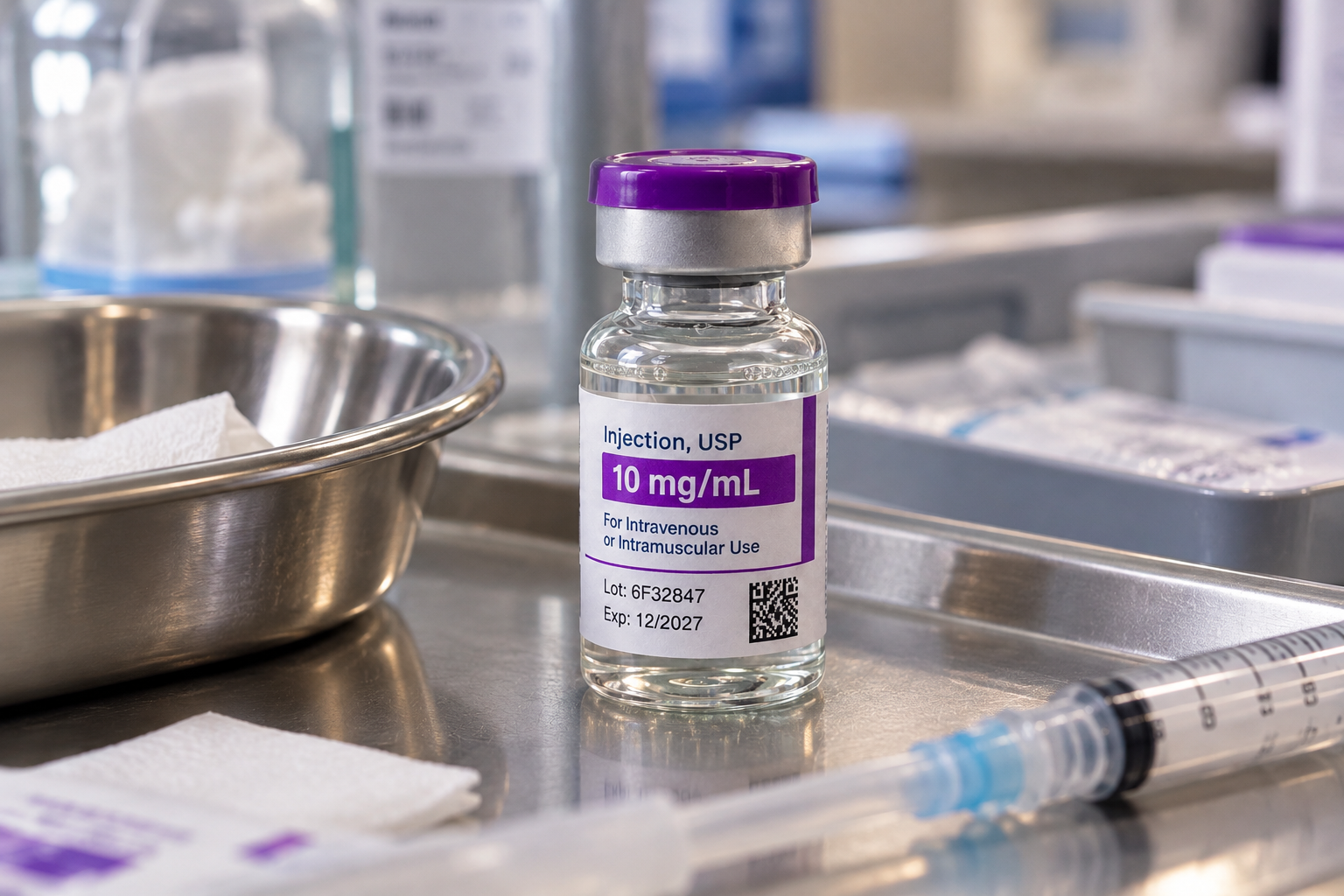
Barcode and Variable Data Considerations for Pharmaceutical Labels
Key Takeaways
- Pharmaceutical labels often need to accommodate barcodes, lot numbers, expiration dates, serial numbers, and other product-specific information.
- GS1 DataMatrix barcodes can encode multiple data elements in a compact format, making them useful for pharmaceutical identification and traceability.
- Variable data printing allows information to change from one label to the next without changing the entire label design.
- Barcode readability depends on more than the barcode artwork. Print quality, contrast, placement, quiet zones, and the label material all matter.
- Accurate data management and verification are just as important as the printing process itself.
Introduction
Pharmaceutical labels do more than identify a product. They help connect each package to important information about its identity, production history, and place in the supply chain.
A single pharmaceutical label may need to display a product identifier, barcode, lot number, expiration date, serial number, dosage information, and other required details. Much of this information can change between production runs or even between individual packages.
That creates a unique challenge for pharmaceutical manufacturers. Labels must accommodate both consistent product information and data that changes throughout production, while maintaining the accuracy and print quality needed for reliable scanning.
Barcode technology and variable data printing help make this possible. However, selecting the right barcode format, planning the label layout, and maintaining data accuracy all play an important role in producing reliable pharmaceutical labels.
Here are several considerations pharmaceutical manufacturers should keep in mind when planning their label requirements.
1. Understand the Role of Barcodes on Pharmaceutical Labels
Barcodes allow product information to be captured quickly and consistently using scanning equipment. In pharmaceutical applications, this can support product identification, inventory management, dispensing workflows, and supply chain traceability.
Different barcode formats serve different purposes, and the right choice depends on the information being encoded, the packaging format, and the scanning systems used throughout the supply chain.
Two common barcode categories include:
Linear Barcodes
Linear barcodes, sometimes called one-dimensional (1D) barcodes, use a series of parallel lines and spaces to represent information.
Common examples include UPC and Code 128. These formats are widely used for product identification and inventory processes.
Traditional linear barcodes generally hold less information than two-dimensional formats. Depending on the application, they may still be required or preferred by specific customers, systems, or regulations.
2D Barcodes
Two-dimensional (2D) barcodes use patterns of squares or other shapes to encode information in both horizontal and vertical directions.
One important example in pharmaceutical packaging is the GS1 DataMatrix barcode.
Unlike a traditional UPC barcode, a GS1 DataMatrix can hold multiple data elements within a relatively small space. Depending on the application, these may include:
- Global Trade Item Number (GTIN), which identifies the product and can incorporate the National Drug Code (NDC)
- Serial number
- Batch or lot number
- Expiration date
This additional capacity makes 2D barcodes useful for applications where individual packages need to be identified and tracked.
The barcode format should always be selected based on the applicable regulatory requirements, customer specifications, and scanning environment. For additional information about GS1 standards and pharmaceutical product identification, see GS1 US’s overview of the Drug Supply Chain Security Act.
2. Know Which Data Needs to Appear on the Label
One of the most important steps in pharmaceutical label planning is identifying exactly what information needs to be printed and what information needs to be encoded in the barcode.
Although these elements may overlap, they do not always serve the same purpose.
For example, a label may display a human-readable lot number and expiration date while also encoding those values within a GS1 DataMatrix barcode.
Common pharmaceutical data elements include:
National Drug Code (NDC): A unique identifier used for drug products in the United States. The NDC identifies the labeler, product, and package configuration.
GTIN: A Global Trade Item Number used within the GS1 system to identify a trade item. Pharmaceutical product identifiers can incorporate the NDC within a GTIN structure.
Lot or batch number: Identifies a specific production batch. This information helps manufacturers and supply chain partners trace products and manage recalls when necessary.
Expiration date: Identifies the date through which a product is expected to meet its established specifications when stored under the appropriate conditions.
Serial number: A unique identifier assigned to an individual package. When used as part of a serialization program, it helps distinguish one saleable unit from another.
Not every pharmaceutical label requires every data element. Requirements vary by product, market, packaging level, and applicable regulations.
Planning these requirements before artwork and production begin helps avoid layout changes, missing information, and unnecessary rework.
3. Understand Serialization and Variable Data Printing
Traditional label printing produces the same artwork across an entire production run. Variable data printing (VDP) makes it possible to change specific elements from one label to the next without creating a separate print file or plate for every variation.
For pharmaceutical manufacturers, this capability is especially important when labels need to include unique or changing information.
Variable data may include:
- Sequential serial numbers
- Lot or batch numbers
- Expiration dates
- Barcodes and 2D codes
- Product identifiers
- Manufacturing or packaging dates
For a broader look at how this technology is used across packaging applications, see Why Variable Data Printing Is Reshaping the Packaging Industry.
What Is Pharmaceutical Serialization?
Serialization assigns a unique identifier to an individual product package. Rather than identifying only the product type or production batch, serialization helps distinguish one package from another.
Under the Drug Supply Chain Security Act (DSCSA), applicable prescription drug products must carry a product identifier at the package level. This includes a standardized numerical identifier, serial number, lot number, and expiration date, represented in a qualifying 2D DataMatrix barcode or another permitted format under the applicable requirements.
Serialization is not simply a matter of printing a different number on each label. The printed information must correspond to the correct product record and remain connected to the manufacturer’s traceability systems.
Why Variable Data Accuracy Matters
A barcode can be printed clearly and still contain incorrect information.
For example, a label may scan successfully but return a serial number that does not match the product record. This creates a data integrity problem even though the physical barcode appears acceptable.
Manufacturers should consider how variable data is:
- Generated and assigned
- Transferred to the printing system
- Matched to the correct product and production order
- Verified during production
- Reconciled with production and traceability records
The printing process and the data management process need to work together. Accurate variable data is essential to making barcode-based identification and traceability useful.
Variable data can also support additional label features, including consecutive numbering and security elements. Inovar explores some of these applications in Keep Your OTC Pharmaceutical Products Secure with These Features.
4. Design Labels for Reliable Barcode Scanning
Barcode placement and print quality can directly affect whether a label scans reliably.
A barcode that is too small, distorted, poorly positioned, or printed with insufficient contrast may create problems for scanners and downstream systems.
Several design considerations deserve attention.
Size and Resolution
Barcodes need to be printed at a size that meets the applicable specifications and can be read by the intended scanning equipment.
Reducing a barcode to fit a crowded label can affect the size of individual elements and make scanning less reliable. This is particularly important with small pharmaceutical containers, where available label space is limited.
The final barcode size should be established with the required data capacity, symbol specifications, printing process, and scanner capabilities in mind.
Contrast and Print Quality
A barcode needs sufficient contrast between its printed elements and the background.
Dark barcodes on light backgrounds are common because they provide strong contrast. However, the actual print quality matters just as much as the color combination.
Potential problems include:
- Ink spread or excessive ink coverage
- Missing or distorted barcode elements
- Inconsistent print density
- Smudging or abrasion
- Poor registration
- Uneven printing across the label
These issues can interfere with scanning even when the barcode appears acceptable to the naked eye.
Quiet Zones and Clear Space
Most barcode formats require a designated area of clear space around the symbol. This is commonly referred to as the quiet zone.
Nearby text, graphics, borders, or other printed elements can interfere with barcode recognition if they extend into this area.
When designing pharmaceutical labels, barcode placement should be planned early rather than treated as an element that can simply be added to the remaining space.
Placement on the Package
A barcode may be printed perfectly but still be difficult to scan if it is positioned over a curved surface, near a seam, or in an area that becomes obstructed when the product is packaged.
Manufacturers should consider the finished container, not just the flat label artwork. The barcode needs to remain accessible to scanning equipment once the label is applied.
5. Consider the Label Material and Printing Process
The substrate and printing method can influence the quality, durability, and consistency of variable data.
Pharmaceutical labels may be applied to small vials, bottles, cartons, syringes, and other packaging formats. Each application presents different requirements for adhesion, surface conditions, available print space, and handling.
A label intended for a small glass vial, for example, may require different material and construction considerations than a label applied to a larger plastic bottle.
When selecting a label construction, consider:
Surface compatibility: The label must adhere properly to the container and remain in place throughout storage, distribution, and use.
Durability: Printed information needs to remain legible under expected handling and environmental conditions. Depending on the application, resistance to moisture, chemicals, abrasion, or temperature changes may be important.
Print consistency: The selected printing process must be capable of producing clear, consistent barcode elements and readable variable information.
Available space: Small containers may require careful placement of barcodes and human-readable information. In some cases, extended content labels can provide additional room for required information without increasing the package footprint.
Application requirements: Label placement, container geometry, and application speed should be considered to help prevent wrinkles, distortion, or other issues that could affect barcode readability.
Material selection is especially important for pharmaceutical and healthcare applications. Inovar’s article on Selecting the Right Label Materials for OTC Pharmaceuticals and Supplements explores some of the considerations involved.
The best solution depends on the specific product, packaging format, and production environment. Material and printing decisions should be evaluated together rather than independently.
6. Build Verification Into the Production Process
Barcode quality should be evaluated as part of the manufacturing process, not just during the initial artwork approval.
A visual inspection can identify obvious printing defects, but it does not necessarily confirm that a barcode meets the required quality specifications or contains the correct information.
A strong verification process considers both the printed symbol and the data it represents.
Barcode Verification
Barcode verification evaluates the quality of a printed barcode against defined standards. Depending on the application, verification may assess factors such as symbol contrast, modulation, defects, and decoding performance.
This is different from simply scanning a barcode. A scanner confirms that it can read a particular symbol, while a verifier provides a more detailed assessment of barcode quality.
The required verification method and acceptance criteria should be established with the manufacturer’s quality team and applicable customer or regulatory specifications.
Variable Data Inspection
Variable data also needs to be checked throughout production.
Depending on the system and application, inspection may include:
- Confirming that each barcode can be decoded
- Comparing printed data against the approved production file or database
- Checking serial number sequences for duplicates or omissions
- Confirming that lot numbers and expiration dates match the production order
- Maintaining records of data and label production
For serialized products, the relationship between the printed identifier and the corresponding product record is especially important.
A well-planned inspection process helps identify problems before affected labels or products move further through the supply chain.
7. Keep Up With Changing Barcode and NDC Requirements
Pharmaceutical labeling requirements and industry standards continue to evolve. Manufacturers should work with their regulatory and quality teams to understand how these changes affect their packaging and labeling programs.
Two important areas to monitor are DSCSA requirements and the FDA’s updated NDC format rule.
DSCSA and Product Identification
The Drug Supply Chain Security Act established requirements intended to improve the security of the U.S. prescription drug supply chain.
For applicable products, the package-level product identifier includes a standardized numerical identifier, serial number, lot number, and expiration date. GS1 DataMatrix is commonly used to carry this information.
Manufacturers should ensure that their barcode strategy, variable data process, and traceability systems are aligned with the requirements applicable to their products.
For more information, the FDA’s DSCSA resources provide background on the law and its product identification and tracing requirements.
FDA’s Upcoming NDC Format Change
In March 2026, the FDA finalized a rule that will standardize FDA-assigned National Drug Codes to a 12-digit format.
The standardized format will consist of:
- A six-digit labeler code
- A four-digit product code
- A two-digit package code
The final rule also updates the FDA’s drug product barcode requirements to permit qualifying linear or nonlinear barcode formats that conform to recognized standards and are recognized by the relevant FDA Center Director.
The rule’s effective date is March 7, 2033. Although this transition is several years away, pharmaceutical manufacturers should monitor FDA guidance and assess how the change may affect product identifiers, label artwork, barcode systems, and related data processes.
For the full details, see the FDA’s final rule on revising the National Drug Code format and drug label barcode requirements.
The change is a good reminder that pharmaceutical label designs and production systems need to accommodate evolving requirements.
8. Plan Barcode and Variable Data Requirements Before Production
Many barcode and variable data issues can be avoided by addressing requirements early in the label development process.
Before moving into production, pharmaceutical manufacturers should confirm:
- Which barcode format is required
- What information must be encoded
- Which information must also appear in human-readable form
- Whether serialization is required
- How variable data will be generated and supplied
- How printed information will be verified
- What barcode quality standards and acceptance criteria apply
- Whether the label material and construction are appropriate for the container
- How the finished package will be presented to scanning equipment
It is also important to involve the label manufacturer early. Reviewing barcode dimensions, data requirements, material selection, and printing capabilities before artwork is finalized can help prevent costly changes later.
The Bottom Line
Pharmaceutical barcode labels require more than a scannable symbol. They bring together product identification, variable data accuracy, print quality, material performance, and traceability requirements.
As serialization and digital identification become increasingly important throughout the pharmaceutical supply chain, manufacturers need to consider how their label designs and production processes support both the physical barcode and the data behind it.
Working with an experienced label manufacturer can help identify potential challenges early, evaluate appropriate materials and printing methods, and produce labels designed for reliable performance throughout the product’s lifecycle.
At Inovar Packaging Group, we offer custom label solutions that can incorporate variable data, barcodes, and sequential numbering to support product identification and tracking needs. Our team can help evaluate label construction, printing capabilities, and application requirements for pharmaceutical and healthcare products. Learn more about Inovar’s healthcare packaging solutions.
Frequently Asked Questions
What information is typically included in a pharmaceutical barcode?
Depending on the barcode format and application, pharmaceutical barcodes may encode a product identifier, lot or batch number, expiration date, and serial number. GS1 DataMatrix is commonly used for pharmaceutical applications that require multiple data elements.
What is the difference between a barcode and a serialized barcode?
A standard barcode may identify a product type or package configuration. A serialized barcode includes a unique identifier for an individual package, allowing it to be distinguished from other packages of the same product.
What is a GS1 DataMatrix barcode?
A GS1 DataMatrix is a two-dimensional barcode that uses GS1 standards to encode information such as a product identifier, lot number, expiration date, and serial number. Its compact format makes it useful for pharmaceutical packaging where space may be limited.
Why is variable data printing important for pharmaceutical labels?
Variable data printing allows information such as serial numbers, lot codes, expiration dates, and barcodes to change from one label to the next. This supports product identification, serialization, inventory management, and traceability without requiring a completely different label design for each variation.
How can manufacturers ensure pharmaceutical barcodes scan correctly?
Manufacturers should consider barcode size, contrast, print quality, quiet zones, placement, and the finished package geometry. They should also establish appropriate barcode verification and variable data inspection processes based on the applicable standards and requirements.
Does every pharmaceutical product require a 2D barcode?
No. Barcode requirements depend on the product, its regulatory classification, packaging level, and applicable regulations. Certain prescription drug products are subject to DSCSA product identifier requirements, while other products may have different barcode requirements. Manufacturers should confirm their specific obligations with their regulatory and quality teams.
What is changing with the FDA’s NDC format?
The FDA finalized a rule in March 2026 that will standardize FDA-assigned NDCs to a 12-digit format consisting of a six-digit labeler code, four-digit product code, and two-digit package code. The rule takes effect March 7, 2033.
THE LATEST FROM INOVAR



WE'RE HERE TO SERVE YOU
Creating and producing labels can be overwhelming, but our experts are here to guide you every step of the way. Whether you have a project ready to go, have questions about label applications or materials, or want to learn more about our services, our team is ready to assist you.