


Designing Multi-Layer Labels for Small Packaging Formats
Key Takeaways
- Multi-layer labels provide additional space for product information without increasing the package’s physical footprint.
- Different constructions, including booklet, leaflet, peel-and-reveal, and two-ply labels, serve different packaging and information needs.
- A successful design balances required information, readable typography, brand presentation, and ease of use.
- Material selection, adhesive, opening method, and application equipment should be considered early in the design process.
- Testing the finished label on the actual package helps identify issues with opening, resealing, durability, and application.
Making More Room on Small Packages
Small packaging creates a familiar challenge for brands: there is often more information to communicate than there is space to display it.
A compact bottle, tube, jar, or container may need to accommodate ingredients, instructions, warnings, usage directions, multiple languages, and branding. Trying to fit everything onto a traditional single-panel label can result in crowded layouts, smaller text, and limited room for product messaging.
Multi-layer labels offer another approach.
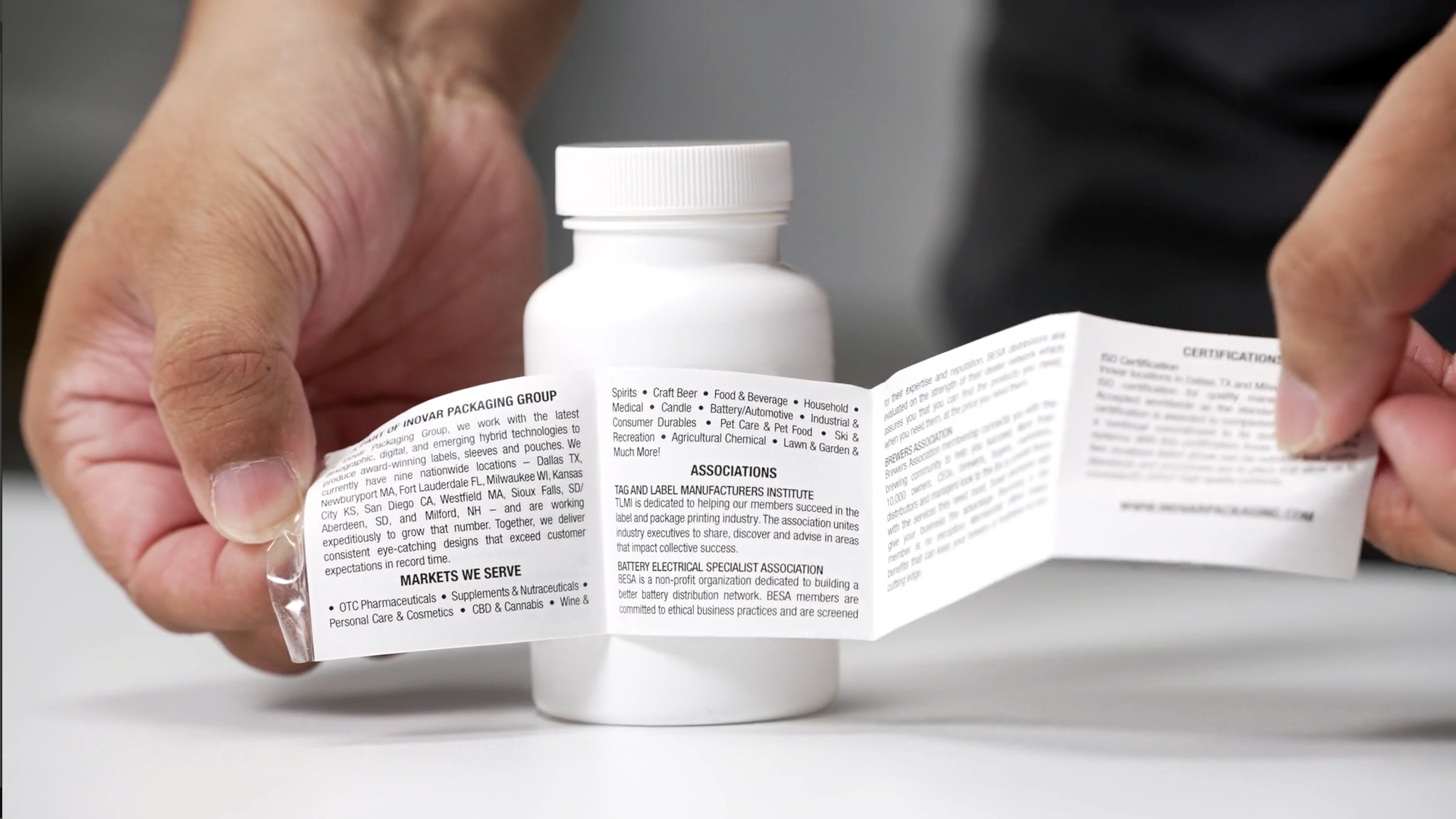
Also called extended content labels (ECLs), these constructions use additional printable surfaces that can peel back, fold out, or open like a booklet. This allows brands to include more information while keeping the label attached to the package and maintaining a compact exterior design.
For products with limited packaging space, the challenge is not simply adding more panels. It is organizing the information so customers can find what they need, read it comfortably, and interact with the label without difficulty.
Here are seven important considerations when designing multi-layer labels for small packaging formats.
1. Determine How Much Information the Label Needs to Hold
Before choosing a multi-layer construction, start by understanding the amount and type of information the label needs to communicate.
A small package may require much more than a product name and basic description. Depending on the product and market, the label may need to include:
- Ingredient or material lists
- Directions for use
- Safety warnings and precautions
- Dosage or application instructions
- Storage information
- Multiple language translations
- Regulatory disclosures
- Product details, diagrams, or promotional content
Separate the information into categories before beginning the design.
For example, the outer panel may contain the product name, brand identity, and primary product information. Inner panels can provide additional instructions, translations, or supporting details.
This approach helps establish a logical reading order and prevents every piece of information from competing for attention on the front of the package.
It is also important to identify which information must appear in a specific location or format. Multi-layer labels provide additional space, but they do not automatically change applicable labeling requirements.
Design tip: Gather and approve the required copy before developing the label structure. Knowing the amount of content early makes it easier to determine the number of panels and the appropriate format.
2. Choose the Right Multi-Layer Label Construction
Not all multi-layer labels open or function the same way. The best construction depends on how much information is needed, how customers will interact with the label, and how the package will be used.
Common extended content label formats include:
Booklet Labels
Booklet labels use a hinged or bound multi-page construction that opens to reveal additional information. They are useful when a product requires extensive instructions, multiple languages, or detailed regulatory content.
Some booklet constructions can be resealed after opening, allowing customers to revisit the information while keeping it attached to the product.
Leaflet Labels
Leaflet labels use folded panels that expand to provide additional printable space. They can be a good option for smaller containers that need more information than a standard label can accommodate.
Peel-and-Reveal Labels
Peel-and-reveal labels allow the top layer to lift away, exposing additional information underneath. Depending on the construction, the top layer may be removable or designed to be reapplied.
These labels can provide extra room for instructions, product details, promotions, or multilingual content.
Two-Ply Labels
Two-ply labels use two connected layers to provide additional printable surfaces. Depending on the format, the top layer can peel back to reveal the information underneath.
They can be useful for products that need additional content while maintaining a familiar label appearance.
| Label format | Common application |
| Booklet labels | Extensive instructions, multiple languages, and detailed product information |
| Leaflet labels | Fold-out information for small containers |
| Peel-and-reveal labels | Additional content beneath a removable or liftable top layer |
| Two-ply labels | Additional information within a compact label construction |
| Peel-and-reseal labels | Information that customers may need to access repeatedly |
Inovar offers several extended content and booklet label solutions, including booklet, leaflet, two-ply, and peel-and-reseal constructions.
Design tip: Choose the opening format based on how much information needs to be included and how frequently customers will need to access it.
3. Prioritize Readability Over Fitting Everything on One Panel
One of the biggest mistakes in small-format label design is trying to fit too much information onto the visible panel.
Shrinking the type may seem like an easy solution, but it can make important information difficult to read. Multi-layer labels are designed to create additional space, so use that space strategically.
Start by establishing a clear hierarchy:
- Primary panel: Product name, brand identity, and the most important product information.
- Secondary panels: Supporting details, ingredients, directions, and additional product information.
- Interior panels: Longer instructions, translations, warnings, and other detailed content.
Typography should remain consistent and readable across the different panels. Consider font size, line spacing, contrast, and the amount of text on each page.
Avoid placing important information too close to folds, perforations, die-cut edges, or areas that may be difficult to view when the label is opened.
For regulated products, readability is especially important. For example, the FDA Cosmetics Labeling Guide discusses requirements for prominent, conspicuous, and legible cosmetic labeling. Brands should review the requirements applicable to their specific product and market.
Design tip: If the text becomes difficult to read at the intended finished size, reconsider the panel layout or construction rather than automatically reducing the font size.
4. Organize Multiple Languages and Instructions Carefully
Multi-layer labels are especially useful for products distributed across different language markets.
Instead of creating separate packaging versions for every market, a multi-panel or booklet construction can provide space for multiple translations within one label format.
However, adding languages requires more than copying translated text into additional panels. The information should be organized so customers can quickly identify the section they need.
Consider these approaches:
- Dedicate specific panels to individual languages.
- Use consistent headings and formatting across translations.
- Keep warnings and important instructions easy to locate.
- Use clear visual separators between language sections.
- Avoid mixing languages within the same instruction unless necessary.
- Confirm that translated copy has been reviewed and approved.
For products with detailed usage instructions, diagrams or simple illustrations may also help communicate information across language barriers.
The ISPE Good Practice Guide for Booklet Labels addresses the design and organization of booklet labels, particularly for pharmaceutical applications and clinical trial materials.
Design tip: Build a consistent layout system that can accommodate different languages without changing the overall structure of the label.
5. Consider the Physical Construction, Materials, and Adhesives
A multi-layer label is more complex than a standard single-panel label. Its layers need to work together mechanically as well as visually.
The base label must remain securely attached to the package, while the additional panels need to open as intended. Depending on the construction, the label may also need to reseal, withstand repeated handling, or protect printed information from moisture and abrasion.
Important considerations include:
- Base material: Must be suitable for the container and application environment.
- Top layer: Should provide the desired appearance, durability, and opening experience.
- Adhesive: Must maintain the required bond while allowing the intended peel or reseal function.
- Lamination or protective coatings: May help protect printed surfaces, depending on the construction.
- Folds and hinges: Need to be positioned so panels open cleanly without interfering with important content.
- Perforations and opening features: Should make the label intuitive to use without compromising its integrity.
Material selection can also affect how the finished label handles during printing, converting, dispensing, and application. The added thickness of multiple layers may require specific equipment settings or construction adjustments.
Technical coverage from Labels & Labeling on multi-layer and leaflet constructions explains why material properties, registration, and construction details matter when producing extended-content labels.
Design tip: Involve your label supplier before finalizing the artwork. Reviewing the physical construction early can help prevent design decisions that are difficult to manufacture or apply.
6. Design for the Way Customers Will Open and Use the Label
A multi-layer label should not only contain the right information. It should also be easy for customers to access.
If a customer cannot tell where to peel, how to unfold the label, or how to close it again, the additional information may not be as useful as intended.
Think about the experience from the customer’s perspective.
Ask:
- Is the opening edge easy to locate?
- Is there enough space to lift the top layer?
- Does the label open without tearing?
- Can customers follow the panels in the correct order?
- Can the label be resealed if information needs to be accessed again?
- Does the label remain attached during normal handling?
- Is the printed information protected during use?
Small containers can make these considerations more challenging because there is less room for opening tabs, hinges, and other functional features.
Simple design cues, such as a clearly positioned peel indicator or consistent panel numbering, can make the label easier to understand.
Design tip: Create a physical sample and ask someone unfamiliar with the product to open and navigate it. Their experience can reveal usability issues that may not be obvious during the design process.
7. Test the Finished Label on the Actual Package
A multi-layer label may look perfect in an artwork file but behave differently once it is converted, applied, and handled.
Testing is an important step before approving a final production run.
Evaluate the finished construction on the actual container, not just a flat sample. The package shape, surface material, and application method can all influence performance.
During testing, review:
- Label placement and alignment
- Adhesion to the container
- Opening and resealing performance
- Panel registration and folding
- Print clarity and readability
- Resistance to moisture, handling, and expected environmental conditions
- Dispensing and application through the intended equipment
- Barcode and variable-data readability, where applicable
For products that require repeated access to instructions, test the label through multiple opening and closing cycles.
It is also important to confirm that the finished construction works with the packaging line. A label that performs well by hand may require additional evaluation when applied automatically at production speeds.
Design tip: Include your packaging supplier, production team, and relevant quality or regulatory reviewers in the evaluation process before final approval.
Where Are Multi-Layer Labels Commonly Used?
Multi-layer labels can support a wide range of products, particularly when packaging space is limited but information requirements are extensive.
Common applications include:
| Industry | Potential uses |
| Pharmaceuticals and healthcare | Dosage information, safety instructions, warnings, and multilingual content |
| Supplements and nutraceuticals | Ingredient information, directions, and product details |
| Personal care and cosmetics | Ingredients, usage instructions, and multiple language declarations |
| Agriculture and lawn care | Application instructions, safety information, and precautionary statements |
| Industrial and chemical products | Handling instructions, hazard information, and technical details |
| Food and beverage | Ingredients, recipes, promotional content, and additional product information |
| Pet care | Feeding instructions, product details, and usage guidance |
The appropriate construction depends on the product, container, customer needs, and applicable labeling requirements.
For products with extensive instructions or detailed information, booklet and leaflet formats may provide more space than a conventional single-panel label. Other products may only need a simple two-ply or peel-and-reveal construction.
Designing a Better Label Starts With the Right Structure
Small packaging does not have to mean limited communication.
Multi-layer labels give brands additional space to organize product information, instructions, and messaging while keeping the packaging compact. The key is selecting a construction that supports the amount of content, maintains readability, and provides a positive customer experience.
By considering information hierarchy, panel layout, materials, adhesives, and application requirements early in the process, brands can create labels that work for both the product and the people using it.
Explore Inovar’s extended content and booklet label solutions to see how different multi-layer constructions can support packaging with limited space and extensive information needs.
Frequently Asked Questions About Multi-Layer Labels
What are multi-layer labels?
Multi-layer labels are label constructions with two or more layers or printable panels that provide additional space for product information. They may peel back, fold out, or open like a booklet while remaining attached to the package.
What is the difference between a multi-layer label and an extended content label?
The terms are often used interchangeably. Extended content labels (ECLs) generally describe labels designed to provide more printable space than a standard single-panel label. Multi-layer labels are one way to achieve this through additional layers, fold-out panels, or booklet-style constructions.
Why are multi-layer labels useful for small packaging?
They allow brands to include additional information without increasing the size of the container. This can be useful for products requiring ingredients, instructions, warnings, multiple languages, or other detailed information.
What types of products use booklet labels?
Booklet labels are commonly used for products that require extensive instructions or disclosures, including pharmaceuticals, healthcare products, agricultural chemicals, supplements, and industrial products. They can also support multilingual information and detailed product content.
Can multi-layer labels be resealed after opening?
Yes. Certain constructions are designed to peel open and reapply, allowing customers to access additional information and close the label again. Reseal performance depends on the specific label construction, adhesive, and application.
Can multi-layer labels include multiple languages?
Yes. Additional panels provide space for multiple translations, making them useful for products distributed across different language markets. The layout should clearly separate languages and keep important instructions easy to locate.
Do multi-layer labels work on small bottles and containers?
Yes. Multi-layer labels can be designed for compact packaging, including small bottles, jars, tubes, and other containers. The final construction should be evaluated against the available label area, container shape, application method, and amount of information required.
Can multi-layer labels be applied automatically?
Many multi-layer constructions are designed for roll-based dispensing and automated application. However, equipment compatibility depends on the label format, dimensions, thickness, roll specifications, and application requirements. These details should be reviewed with the label supplier before production.
Disclaimer: This article is intended for general educational purposes only and is not legal or regulatory advice. Labeling requirements vary by product category and market. Consult applicable regulations and qualified regulatory professionals when determining required product information and label content.
THE LATEST FROM INOVAR


WE'RE HERE TO SERVE YOU
Creating and producing labels can be overwhelming, but our experts are here to guide you every step of the way. Whether you have a project ready to go, have questions about label applications or materials, or want to learn more about our services, our team is ready to assist you.